If you have ever asked what is an emergency fund, you are asking the most important question in personal finance.
Imagine this scenario:
It’s Tuesday morning. You walk into work, and your boss calls you into a meeting.
“We are downsizing,” he says. “Today is your last day.”
Or imagine you are driving home, and your car engine explodes. The repair bill is ₹50,000.
In that specific moment, how do you feel?
Do you feel panic? Do you feel your heart racing? Do you wonder how you will pay rent?
Or do you feel annoyed, but calm?
The difference between “Panic” and “Inconvenience” comes down to having a safety net. It comes down to understanding what is an emergency fund and having one ready.
If you don’t have one, you are driving a car without brakes. You might be moving fast, but the first obstacle will destroy you.
What Is an Emergency Fund?
It is exactly what it sounds like.
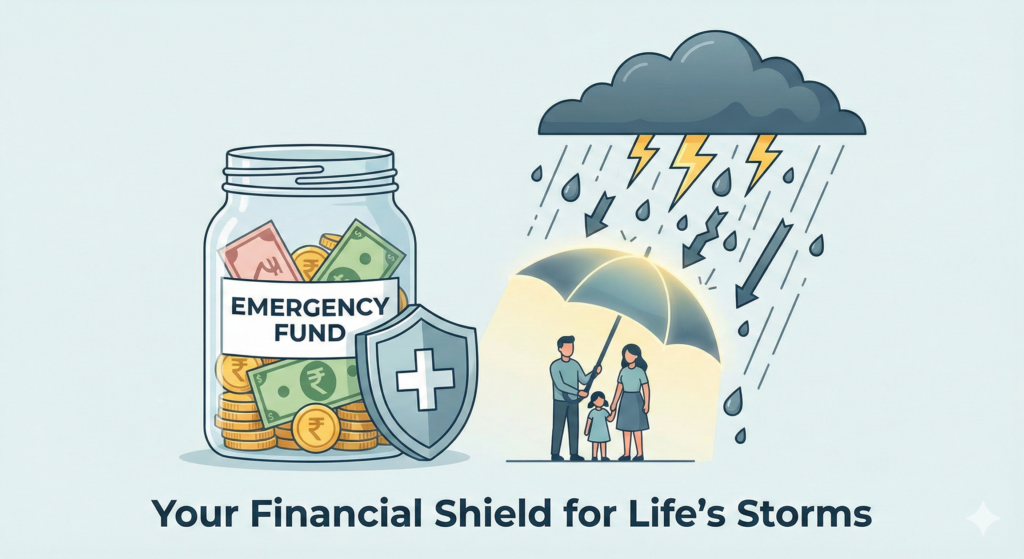
An Emergency Fund is a stash of money set aside specifically to cover unexpected life events.
It is not for a vacation. It is not for a new iPhone. It is not for investing in the stock market.
It is Financial Oxygen.
When life punches you in the face (and it will), this fund is the cushion that softens the blow. It ensures that a temporary problem doesn’t become a permanent financial disaster.
Why Is It More Important Than Investing?
New investors often skip this step. They say, “Why should I keep cash in a bank earning 3% when I can make 15% in the stock market?”
This is a rookie mistake.
If you put all your money into stocks, and the market crashes by 50% (which happens), AND you lose your job at the same time (which often happens during crashes)…
You will be forced to sell your stocks at a loss just to buy food.
You turn a paper loss into a real loss. You kill your Compound Interest machine.
Understanding what is an emergency fund means understanding that it protects your investments. It ensures you never have to sell your assets at the wrong time.
How Much Do You Need? (The Magic Number)
The general rule of thumb is 3 to 6 months of living expenses.
Notice I said expenses, not income.
Go back to your 50 30 20 Rule. Look at your “Needs” bucket.
The Calculation:
- Rent/EMI: ₹15,000
- Food/Groceries: ₹5,000
- Bills/Transport: ₹5,000
- Total Monthly Needs: ₹25,000
Your Emergency Fund Goal:
- Minimum (3 Months): ₹75,000
- Ideal (6 Months): ₹1,50,000
Which one should you choose?
- Choose 3 Months: If you are single, have a stable job, and rent a cheap apartment.
- Choose 6 Months: If you are married, have kids, have a fluctuating income (freelancer/business), or own a home.
Where Should You Keep It? (Liquidity is King)
This is where people get confused about what is an emergency fund designed to do.
The goal of this money is NOT to earn high returns.
The goal is ACCESS (also known as Liquidity).
As defined by financial experts at Investopedia, liquidity is how easily you can convert an asset into cash. If you have an emergency at 2 AM on a Sunday, can you get this money?
- Stock Market: No. Too volatile and takes days to withdraw.
- Real Estate: No. You can’t sell a bathroom to pay a hospital bill.
- Fixed Deposit (Locked): Maybe, but you pay a penalty to break it.
- High-Yield Savings Account: Yes. Instant access.
- Liquid Mutual Funds: Yes. Usually accessible within 24 hours.
My recommendation: Keep 1 month of expenses in your regular Savings Account (for instant access) and the other 5 months in a separate High-Yield Savings account or Liquid Fund that you don’t touch.
When Should You Use It?
You only touch this money if:
- You lose your job.
- You have a medical emergency (not covered by insurance).
- Your car/bike breaks down (and you need it for work).
- Your house needs urgent repairs (leaking roof).
What is NOT an emergency:
- A flash sale on Amazon.
- Your best friend’s destination wedding.
- Concert tickets.
Final Thought: The “Sleep Well” Fund
I like to call this the “Sleep Well Fund.”
When you have 6 months of expenses sitting in the bank, you walk differently. You are not desperate. You don’t tolerate a toxic boss because you are terrified of being fired. You negotiate better because you can afford to walk away.
Money buys freedom. Now that you know what is an emergency fund, go build that freedom.
In the next article, we will finally talk about Investing Basics—how to actually make your money grow now that you are safe.
Quick Action Step:
Check your bank balance right now.
Do you have ₹50,000 sitting there that isn’t for bills?
If not, pause all other investing. Pause the extra payments on debt.
Focus 100% of your energy on building a 1-Month Mini Emergency Fund first.
Then, expand it to 6 months.