
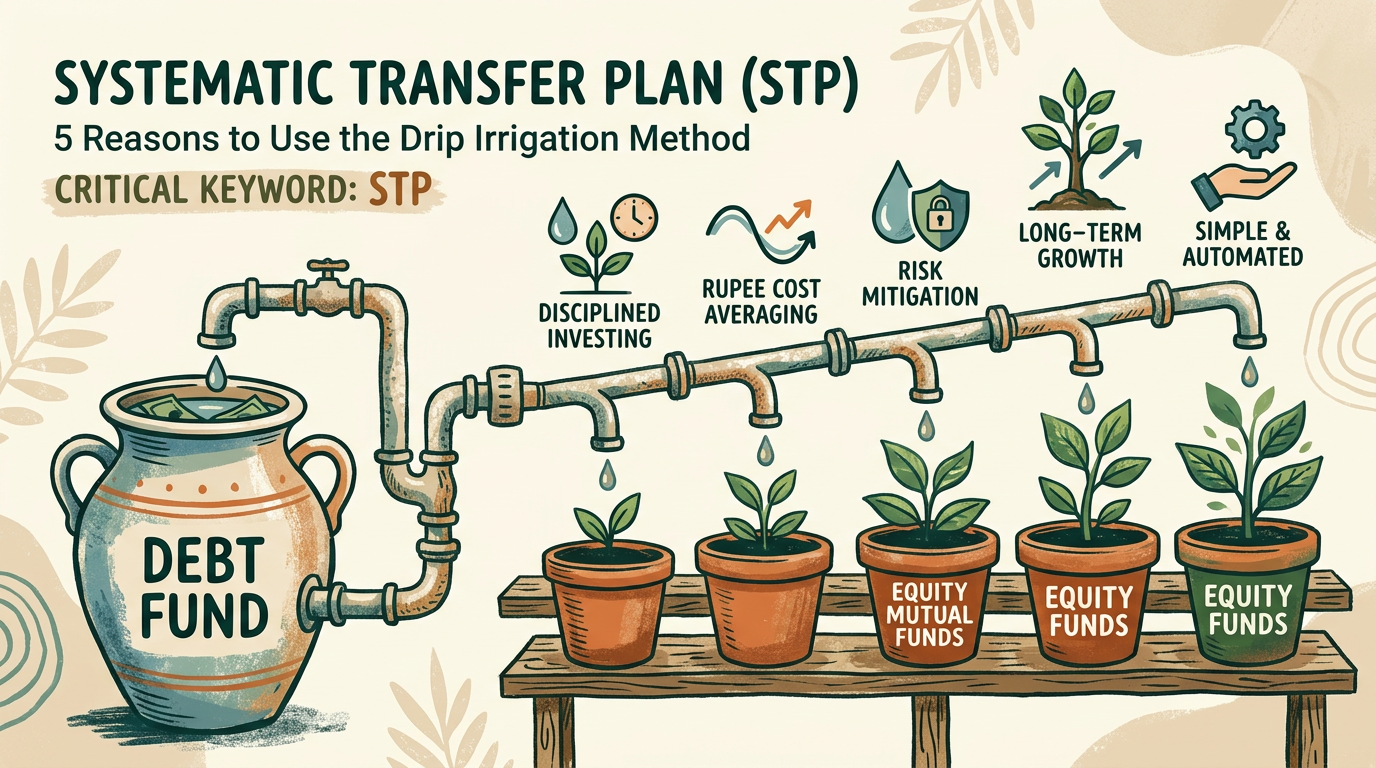
Investing in the stock market can feel like trying to drink from a firehose. One wrong move, and you might get overwhelmed by volatility. This is where the STP (Systematic Transfer Plan) comes into play, acting as the ultimate drip irrigation system for your wealth.
Much like a farmer uses drip irrigation to nourish crops slowly, an STP (Systematic Transfer Plan) allows you to move your capital gradually from a low-risk fund into a high-growth equity fund. This strategy is essential for anyone looking to master their money management journey.
Understanding the Mechanics of STP
An STP (Systematic Transfer Plan) is a facility offered by mutual funds that allows an investor to transfer a fixed amount from one scheme to another at regular intervals. Typically, you park a lump sum in a Liquid Fund and slowly drip-feed it into an Equity Fund.
This method helps in averaging your cost of purchase over time. By not deploying all your money at once, you protect yourself from market timing risks.
1. The Role of Liquid Funds as a Foundation
Before initiating an STP (Systematic Transfer Plan), you must park your capital in a Liquid Fund. These funds are designed for safety and liquidity.
- They invest in short-term debt instruments.
- They offer better returns than a standard savings account.
- They provide the stability required to fund your equity transfers.
By keeping your money here, you ensure that your principal is relatively safe while waiting for the equity market to present buying opportunities.
2. Eliminating the Stress of Market Timing
Many investors lose sleep trying to predict the next market crash. With an STP (Systematic Transfer Plan), you remove the need for perfect timing.
Because you are investing in smaller, consistent tranches, you buy more units when the market is down and fewer when it is high. This discipline is a hallmark of successful long-term wealth creation.
3. Enhancing Returns via Rupee Cost Averaging
The core benefit of an STP (Systematic Transfer Plan) is Rupee Cost Averaging. Instead of worrying about daily price fluctuations, you focus on the long-term growth of your portfolio.
If you have ₹10,00,000 to invest, you don’t need to risk it all on a single day. You can set up an STP to move ₹20,000 every month, smoothing out the volatility of the equity markets.
4. Maintaining Liquidity and Flexibility
One of the most attractive features of an STP (Systematic Transfer Plan) is its flexibility. You can stop, pause, or modify the transfer amount at any time.
Investors should always consult official guidelines from the Reserve Bank of India to understand the broader economic environment affecting interest rates and debt fund performance.
5. Tax Implications of Systematic Transfers
It is crucial to remember that every transfer from a Liquid Fund to an Equity Fund is considered a redemption. Therefore, each transfer triggers a capital gains tax event.
- Short-term capital gains are taxed as per your income tax slab.
- Ensure you calculate the post-tax returns before finalizing your plan.
- Always keep your tax records updated for annual filings.
Why Every Investor Needs an STP
The STP (Systematic Transfer Plan) is not just for the wealthy; it is for the disciplined. By automating your investments, you remove emotional bias from your financial decisions.
Whether you are investing ₹5,000 or ₹5,00,000, the logic remains the same. Use the drip irrigation method to grow your wealth steadily and securely.