Ever handed over a ₹100 note for chai and thought, “Wait, what did I just give away?”
It’s just a piece of paper. It has a picture of Gandhi on it. It costs maybe ₹3 to manufacture. Yet, the chaiwala hands you a steaming hot cup of tea, biscuits, and a smile in return.
We touch money every day. We fight over it, dream about it, stress about it, and sometimes pretend it doesn’t control our lives. But when someone asks the most basic question—what is money?—we freeze.
It’s not because the answer is complicated. It’s because the concept feels so normal that we never stop to question it. We assume it has value because… well, it just does.
Let’s pull back the curtain and fix that right now by exploring the fundamentals of finance.
What Is Money? (The One-Sentence Answer)
If you memorize one thing today, make it this definition. To understand what is money, you only need to know this:
Money is anything a group of people agree has value and will accept for goods or services.
That’s it.
No magic. No secret banker spells. No divine blessing. Just collective belief.
Money is a social contract. It works only because we all agree to hallucinate that it works.
If tomorrow everyone decided that bottle caps were worth more than gold—boom, bottle caps become money. You’d be haggling at the kirana store: “Bhaiya, two cold drinks for 17 caps?”
Conversely, if everyone stops believing in the ₹2000 note (as happened in India recently), it instantly turns back into a worthless piece of paper.
Why Do We Even Need This Weird Invention?
To truly grasp what is money, you have to imagine life without it.
Picture this: You grow the world’s best tomatoes. Your neighbor makes killer biryani. Life would be perfect… except your neighbor hates tomatoes.
Enter the problem: The Double Coincidence of Wants.
In the Dark Ages of barter trading, a transaction only happened if two people wanted exactly what the other person had at the exact same time.
You: “I’ll trade 5kg of my amazing tomatoes for your bicycle.”
Her: “I don’t like tomatoes. I need clothes.”
You: “But I don’t have clothes…”
[Deadlock. Everyone goes home angry.]
This system was inefficient and exhausting. You spent half your life looking for someone who wanted your tomatoes and had the thing you wanted.
Enter Money – The Universal Translator.
Money solves this mess by acting as a middleman. You sell tomatoes for money. You take that money and buy a bicycle. The bicycle seller takes that money and buys clothes. Everyone wins.
Money’s 3 Superpowers (The Functions You Need to Know)
Money isn’t random. Economists (and sites like Investopedia) define what is money by looking at what it does. It has three specific jobs:

1. Medium of Exchange The Trading Hero
This is the most obvious function. It facilitates trade.
Instead of: “3 chickens for one haircut?”
You say: “₹200 please.”
Done. No drama.
2. Unit of Account
Imagine trying to build a house if you measured the walls in “bananas” and the roof in “cows.” It would be a disaster.
Money gives us a common language for value:
- Vada pav: ₹20
- iPhone: ₹80,000
- Dream house: ₹80,00,000
It allows us to compare the value of two completely different things instantly.
3. Store of Value Your Future Self Thanks You
Tomatoes rot. Milk goes bad. Even shoes wear out.
Money allows you to park your labor. You work hard today, earn ₹10,000, and you can “store” that labor to spend it five years from now.
(Warning: There is a thief called Inflation that tries to steal from this store, but we’ll get to that.)
The Evolution: From Cowrie Shells to Crypto
Humans have been desperate to find the perfect currency for thousands of years. We have tried almost everything.
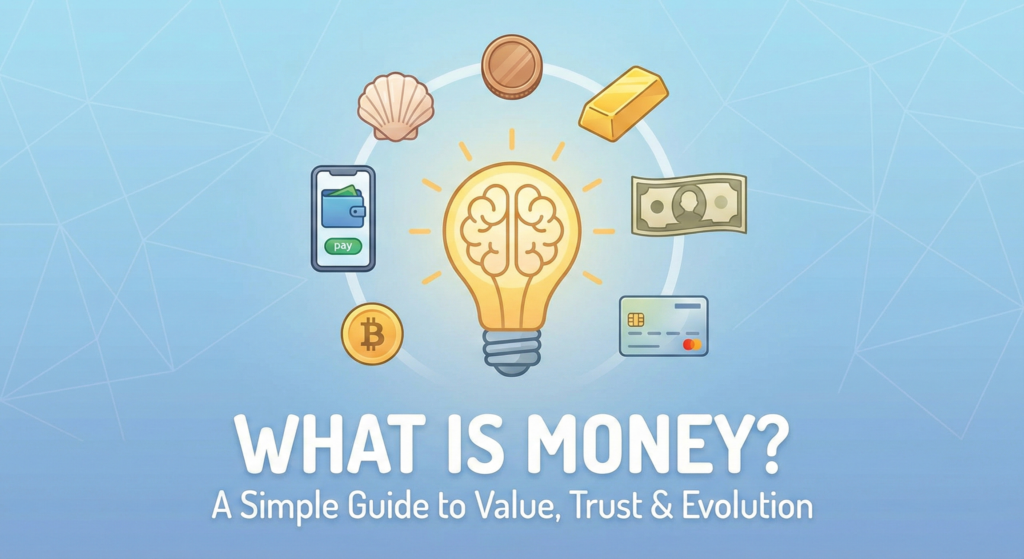
| Era | Money Was | Why It Worked (or Failed) |
|---|---|---|
| Ancient Times | Commodity Money (Salt, Cattle, Shells) |
Pros: Useful (you can eat salt). Cons: Cows die; salt dissolves in rain. |
| Middle Ages | Metal Money (Gold, Silver) |
Pros: Durable, scarce, shiny. Cons: Heavy to carry; dangerous to transport. |
| 1900s | Representative Money (Paper backed by Gold) |
Pros: Light paper represented real gold in a vault. Cons: Banks sometimes printed more paper than they had gold. |
| 1971 – Today | Fiat Money (Paper backed by Nothing) |
Pros: Government controls supply; flexible. Cons: Infinite printing causes inflation. |
| The Future? | Digital/Crypto (Bitcoin, CBDC) |
Pros: Instant, global, programmable. Cons: Volatile; confusing for Grandma. |
The “Fiat” Trick: Why Paper Has Value
This is the part that blows people’s minds when they ask what is money in the modern world.
Today, we use Fiat Currency. “Fiat” is Latin for “let it be done” or “because I said so.”
Unlike the old days, where you could walk into a bank and exchange your paper note for actual gold, today’s money is not backed by anything physical.
So why do we trust it?
- Government Decree: The government declares it “Legal Tender.” If you owe taxes, you must pay in this currency.
- Scarcity: The Central Bank (like the RBI in India) promises not to print so much of it that it becomes worthless confetti (usually).
- Network Effect: Because everyone else accepts it, you accept it.
It is the ultimate “Pinky Promise” between the government and the people.
The 5 Types of Money in Your Pocket
- Cash (M0): The physical notes and coins in your pocket. This is the most liquid form of money. It’s anonymous and works without electricity.
- Central Bank Reserves: Funds that commercial banks hold with the central bank. You never see this, but it keeps the system running.
- Commercial Bank Money: This is the number you see in your banking app. It’s actually just a digital IOU. The bank promises to give you cash if you ask for it.
- Digital Wallets: (PhonePe, GPay, Paytm). This is just a layer on top of bank money to make moving it faster.
- Cryptocurrency: A decentralized ledger (blockchain) that removes the bank entirely. It’s the rebel of the financial world.
Who Controls the Value? (The Real Answer)
If money is just paper, why can’t we just print more and give everyone a billion rupees?
Short version: Because that breaks the trust.
Honest version:
Value is a balancing act managed by the Central Bank.
- If they print too little: People hoard money, spending stops, and the economy crashes (Recession).
- If they print too much: Too much money chases too few goods, prices skyrocket, and your savings become worthless (Inflation).
When this balance breaks completely, you get Hyperinflation. Look at Zimbabwe or Venezuela, where people carried wheelbarrows of cash just to buy a loaf of bread.
Money ≠ Wealth (The Mistake That Keeps People Broke)
This is where most people get tripped up. They think money and wealth are synonyms. They are not.
Money is the tool (the bicycle).
Wealth is the freedom (the ability to ride anywhere).
Money is liquid. It flows in and out. You use it to buy groceries and pay bills.
Wealth is assets. It is what you own that generates money while you sleep.
True wealth includes:
- Stocks and Bonds
- Real Estate
- Profitable Businesses
- Intellectual Property (Copyrights, Patents)
- Skills that are in high demand
If you have ₹1 Crore in the bank but you spend ₹1.2 Crores a year, you are broke.
If you have ₹50,000 but your investments pay for your lifestyle, you are wealthy.
Why YOU Need to Understand Money (Starting Today)
Financial illiteracy is expensive.
If you don’t understand what is money:
- You let inflation eat your savings (keeping cash under the mattress).
- You confuse “cheap” with “value.”
- You fall for “Get Rich Quick” schemes because you don’t understand risk.
- You work for cash your whole life.
When you do understand it:
- You make money work for you.
- You understand the power of Compound Interest.
- You stop panicking when the news talks about a recession.
- You gain control over your time.
The Final Truth (No BS)
So, what is money really?
It isn’t good.
It isn’t evil.
It is a magnifier.
If you are a generous person, money makes you a philanthropist.
If you are a greedy person, money makes you a tyrant.
It does exactly what the person using it tells it to do. Most people never learn the language, so their money ignores them.
You’re here reading this. You are learning the language.
You’ve already won Round 1.
Quick Action Step for Beginners:
Open your wallet or banking app. Look at the number. Don’t look at it as “spending power.” Look at it as stored energy.
Ask yourself: “Am I going to trade this stored energy for something that grows (assets) or something that disappears (expenses)?”
That one question changes everything.
1 thought on “What Is Money? A Simple Explanation.”
Comments are closed.