
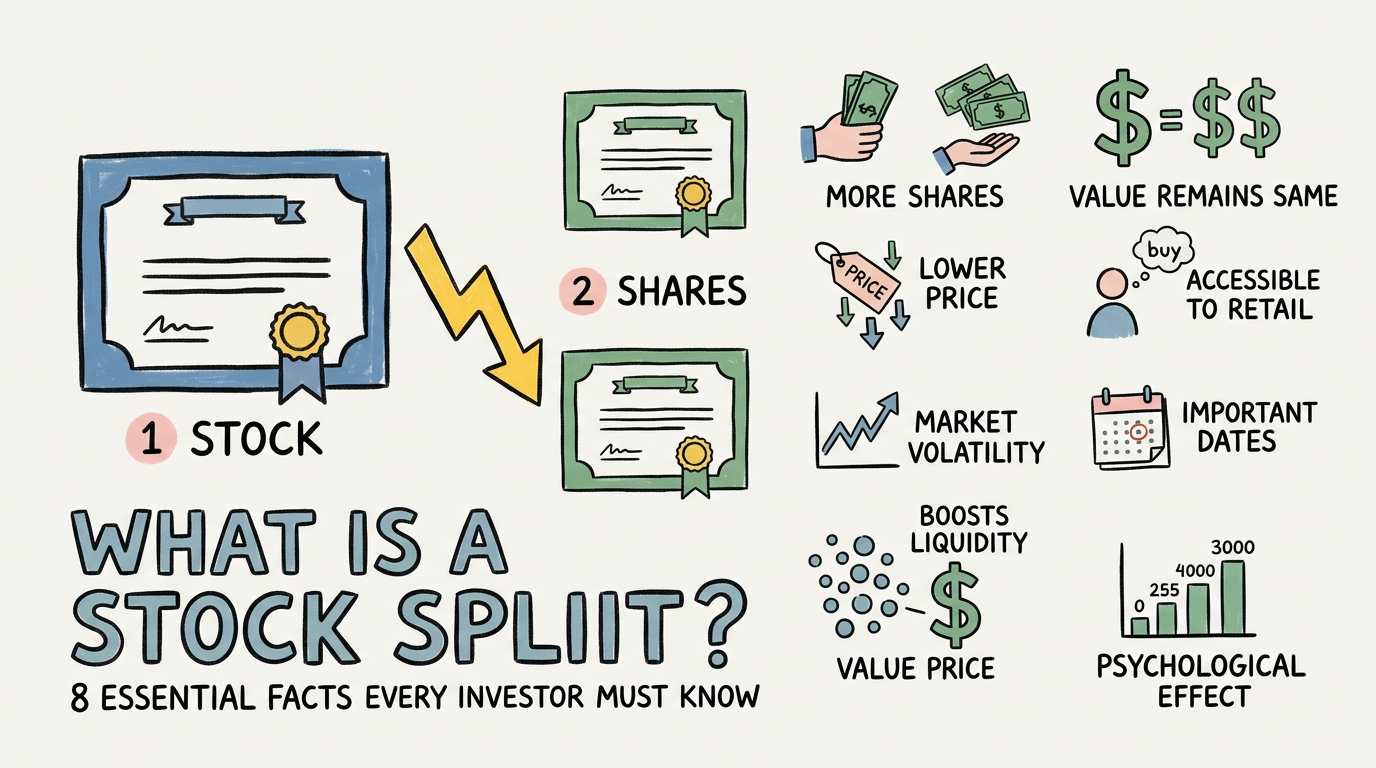
Understanding the stock market can often feel like learning a new language. Among the many terms that confuse beginners, what is a stock split remains one of the most frequently asked questions. At its core, a stock split is a corporate action that increases the number of outstanding shares while decreasing the price per share proportionally.
Think of it like a pizza. If you have a large pizza cut into four slices, each slice is quite substantial. If you decide to cut that same pizza into eight slices, you still have the exact same amount of pizza. However, each individual slice is now smaller and easier to handle. In the world of investing, a stock split works exactly the same way.
When a company decides to execute a split, it does not change the fundamental value of the business. It simply makes the stock more accessible to retail investors who might find the high price per share prohibitive. For more foundational knowledge on money management, explore our comprehensive guides.
1. The Mechanics of a Stock Split
When you ask what is a stock split, you are really asking about how a company adjusts its equity structure. The board of directors authorizes the split to improve liquidity. If a stock is trading at ₹10,000, it might be too expensive for a small investor to purchase a single share.
By implementing a 2-for-1 split, the company doubles the number of shares and halves the price. Now, the stock trades at ₹5,000. The market capitalization remains identical because the total value of all shares combined stays constant.
2. Why Companies Choose to Split Stocks
Companies often wonder what is a stock split good for if it doesn’t change the company’s value? The primary reason is psychological and practical. A lower share price often leads to increased trading volume.
- Increased Liquidity: More shares available at a lower price point encourage more frequent trading.
- Accessibility: Retail investors can participate without needing massive capital.
- Perception of Growth: A company that splits its stock is often signaling confidence in its future performance.
3. The Impact on Your Investment Portfolio
If you hold shares in a company that announces a split, you do not need to worry about your total wealth changing. What is a stock split for your portfolio? It is simply a change in the denomination of your holdings.
If you owned 10 shares worth ₹1,000 each, you had a total investment of ₹10,000. After a 2-for-1 split, you own 20 shares worth ₹500 each. Your total value remains ₹10,000. It is a neutral event for your net worth.
4. Historical Context and Market Regulation
Investors often look to regulatory bodies to understand the rules governing these actions. The Reserve Bank of India provides the broader economic framework within which these financial instruments operate. Understanding what is a stock split requires looking at how these actions have historically been used by blue-chip companies to keep their stocks within a “sweet spot” for investors.
5. Stock Splits vs. Stock Dividends
Many investors confuse these two concepts. While a stock split increases the share count, a stock dividend is a distribution of additional shares to existing shareholders. Both result in more shares, but they are accounted for differently on the balance sheet.
When researching what is a stock split, always check the company’s official announcement. It will specify the ratio, such as 3-for-1 or 5-for-1, which dictates how many new shares you receive for every share you currently hold.
6. The Psychological Effect on Investors
Even though the math is simple, the market often reacts positively to a split. Investors often view a split as a sign that the company’s management believes the stock price will continue to rise. This sentiment can drive demand, potentially pushing the price up after the split occurs.
If you are still wondering what is a stock split, remember that it is a tool for market efficiency. It doesn’t create value, but it does create opportunity by lowering the barrier to entry.
7. Risks and Considerations
While splits are generally positive, they are not a guarantee of future success. A company might split its stock, but if the underlying business is failing, the price will continue to fall regardless of the split. Always perform your own due diligence.
In summary, what is a stock split? It is a strategic move to make shares more affordable. Whether you are a long-term investor or a day trader, understanding this concept is vital for navigating the stock market effectively.
8. Summary of Key Takeaways
To recap, what is a stock split? It is a division of existing shares into multiple, lower-priced shares. Your total investment value does not change, but your share count increases. It is a standard practice used by successful companies to maintain liquidity and attract a broader base of investors.
Always keep an eye on company announcements regarding corporate actions. By staying informed, you can make better decisions about when to buy or hold your investments.