
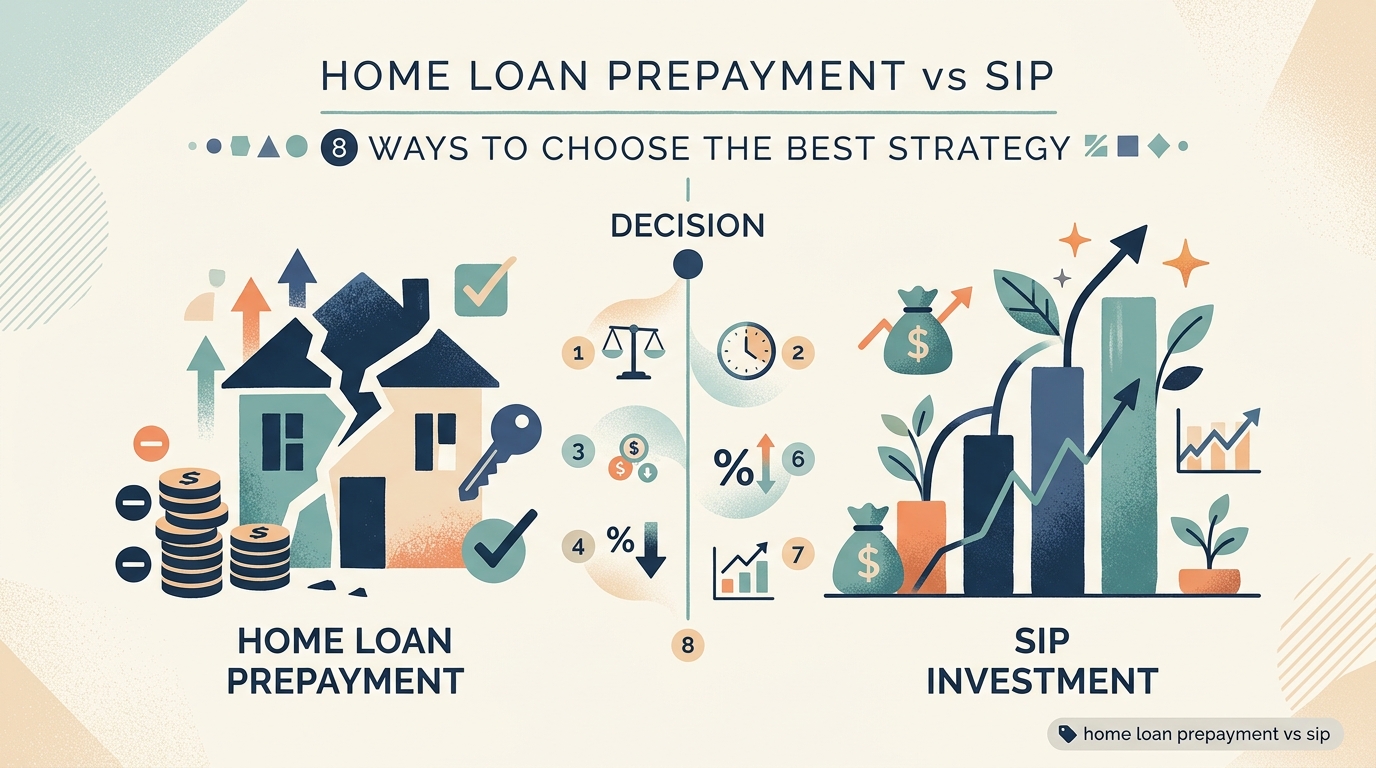
Deciding between home loan prepayment vs sip is a pivotal financial dilemma for many Indian homeowners. You are essentially choosing between the guaranteed savings of interest and the potential for wealth creation through market-linked investments.
Managing your money management strategy effectively requires a deep understanding of how interest rates and compounding work together. Let’s break down the math behind this common financial tug-of-war.
Understanding the Financial Mechanics
A home loan at 9% interest is a significant liability. Every rupee you pay toward the principal reduces the interest burden over the remaining tenure. Conversely, a Systematic Investment Plan (SIP) in equity mutual funds aims for long-term growth, often targeting returns around 12%.
While 12% is higher than 9%, you must consider the tax implications and the risk profile of equity markets. Prepayment offers a guaranteed return equal to your loan interest rate, which is a risk-free proposition.
1. The Guaranteed Savings of Home Loan Prepayment
When you prepay your home loan, you save the interest that would have accrued on that principal amount. If your loan is at 9%, every extra ₹10,000 you pay saves you a significant amount over a 20-year tenure.
This is effectively a 9% tax-free return on your money. For conservative investors, this is often the preferred route because it reduces debt stress and improves cash flow.
2. The Wealth Creation Potential of SIPs
Investing in a SIP allows your money to benefit from the power of compounding. If you invest that same ₹10,000 in a diversified equity fund, you might achieve 12% annual returns over a long horizon.
However, unlike loan prepayment, these returns are not guaranteed. Market volatility can impact your corpus, and you must account for capital gains taxes when you eventually redeem your units.
3. Analyzing the Tax Impact
Home loans offer tax benefits under Section 80C for principal repayment and Section 24(b) for interest payments. Prepaying might reduce your interest burden, potentially lowering your tax deduction eligibility.
Conversely, SIPs in Equity Linked Savings Schemes (ELSS) can help you save tax under Section 80C. You must evaluate your total tax liability before choosing between home loan prepayment vs sip.
4. The Psychological Comfort of Debt-Free Living
Financial decisions are not just about numbers; they are about peace of mind. For many, being debt-free is a primary goal that outweighs the potential for higher investment returns.
If carrying a large debt keeps you awake at night, prioritizing prepayment is the right choice. You can always start an aggressive SIP once the home loan is cleared.
5. Liquidity and Emergency Considerations
Money put into a home loan is locked away. If you face a financial emergency, you cannot easily withdraw your prepaid principal without selling the house or taking a top-up loan.
SIPs, on the other hand, offer high liquidity. You can redeem your mutual fund units within a few days if you need cash urgently. Always maintain an emergency fund before choosing home loan prepayment vs sip.
6. The Impact of Inflation on Debt
Inflation actually works in favor of a home loan borrower. As your salary increases over time, the fixed EMI becomes a smaller portion of your monthly income.
If you have a long tenure, the real value of your debt decreases due to inflation. This makes the home loan prepayment vs sip debate even more nuanced, as delaying payment might be cheaper in real terms.
7. Regulatory Framework and Interest Rates
It is essential to stay updated with the guidelines issued by the Reserve Bank of India regarding floating interest rates. Changes in repo rates directly impact your home loan interest, shifting the balance of your decision.
If interest rates rise, the appeal of home loan prepayment vs sip shifts toward clearing the debt faster. Always monitor the macro-economic environment when planning your long-term finances.
8. Finding the Right Balance
You do not have to choose one exclusively. A balanced approach often works best for most Indian families. You can allocate 50% of your surplus funds to prepay your loan and 50% to your SIP portfolio.
This hybrid strategy helps you reduce debt while simultaneously building wealth. It mitigates the risk of missing out on market gains while ensuring you are not burdened by interest costs.
Final Verdict on Home Loan Prepayment vs SIP
The choice between home loan prepayment vs sip depends on your risk appetite, age, and financial goals. If you are young and have a long investment horizon, SIPs might offer superior wealth creation.
If you are nearing retirement or prefer a debt-free lifestyle, focus on prepayment. Remember, home loan prepayment vs sip is not a one-time decision; it is a dynamic process that should be reviewed annually.
Ultimately, whether you choose home loan prepayment vs sip, the most important factor is consistency. Stay disciplined with your payments and your investments to achieve long-term financial freedom.
As you weigh home loan prepayment vs sip, ensure you have adequate life and health insurance in place. Protecting your family’s future is far more critical than optimizing for a few percentage points of return.
By carefully analyzing home loan prepayment vs sip, you can take control of your financial journey. Make an informed choice that aligns with your personal values and long-term objectives.