
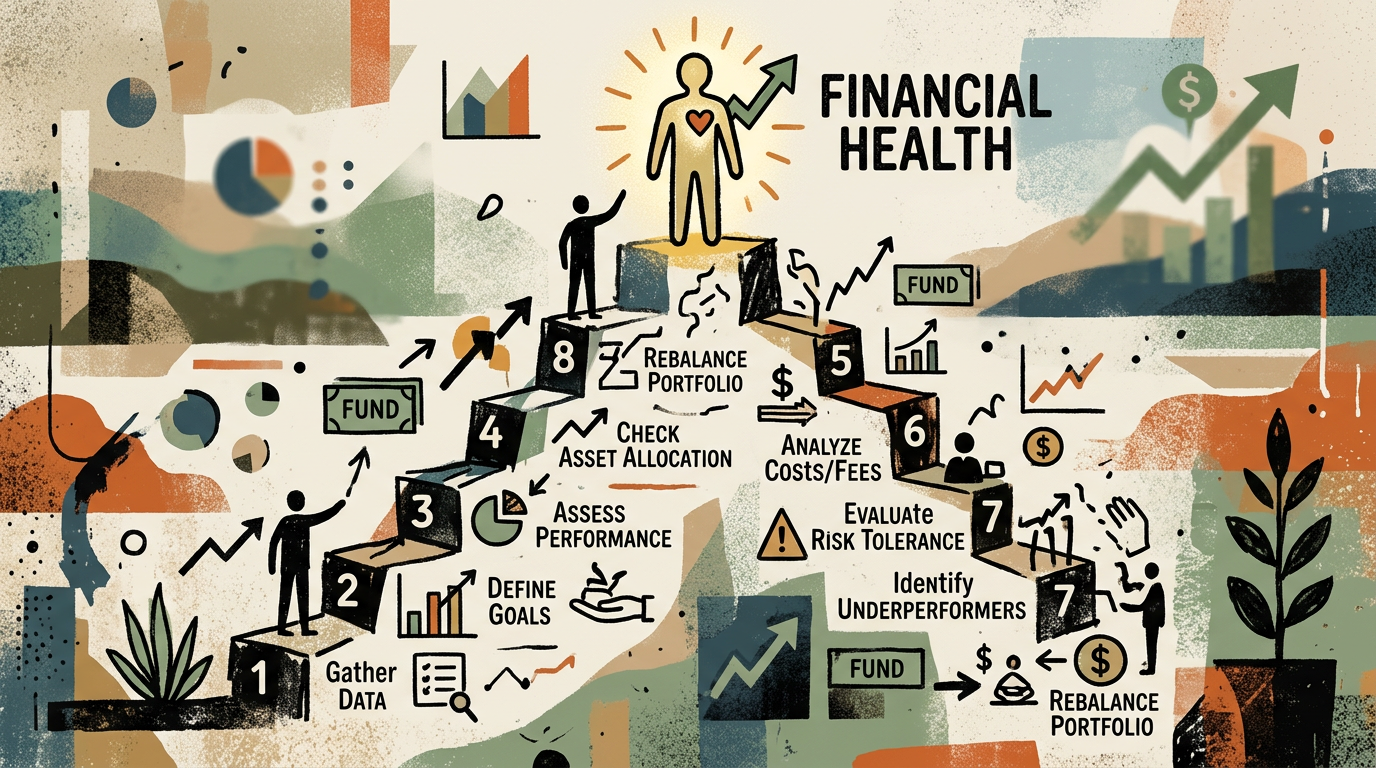
In the world of personal finance, many investors fall into the trap of accumulating funds like collector’s items. They believe that owning 15 or 20 different schemes constitutes a robust strategy. In reality, this is merely financial clutter that dilutes your returns and complicates your tax filings.
Learning how to review mutual fund portfolio performance is the most critical skill for any serious investor. Just like a yearly medical checkup, your investments require a diagnostic review to ensure they are still aligned with your long-term financial goals.
Why Your Portfolio Needs a Yearly Health Checkup
Markets are dynamic, and your personal life is constantly evolving. A fund that performed exceptionally well three years ago might now be struggling due to a change in fund management or shifting market cycles.
When you master how to review mutual fund portfolio health, you stop guessing and start managing. This process allows you to prune underperformers, consolidate overlapping holdings, and ensure your asset allocation remains balanced.
1. Audit Your Asset Allocation Strategy
The foundation of your wealth is your asset allocation. If you are young, your portfolio should lean heavily toward equity. As you approach your goals, you must shift toward debt to protect your capital.
If your equity allocation has drifted significantly due to market gains, you are taking on more risk than intended. Use this time to rebalance your portfolio to match your original risk tolerance.
2. Eliminate Overlapping Holdings
Many investors hold multiple large-cap funds, thinking it provides diversification. However, if these funds hold the same 30 stocks, you are not diversified; you are just paying multiple expense ratios.
When you learn how to review mutual fund portfolio structure, you will notice that holding 3-4 well-chosen funds is often superior to holding 15. Simplify your life by keeping only the best-performing funds in each category.
3. Compare Against Relevant Benchmarks
A fund might show a 12% return, but is that good? If the benchmark index returned 15%, your fund is actually underperforming significantly.
Always compare your fund’s performance against its specific benchmark, such as the Nifty 50 or Nifty Midcap 150. If a fund consistently lags behind its benchmark, it is time to consider a switch.
4. Analyze Expense Ratios and Costs
High expense ratios eat into your compounding over the long term. Even a 1% difference in fees can result in a loss of lakhs of rupees over two decades.
Check if you are invested in “Direct” plans. Direct plans have lower expense ratios than “Regular” plans because they exclude distributor commissions. Switching to direct plans is a simple way to boost your returns immediately.
5. Evaluate Fund Manager Stability
The fund manager is the captain of the ship. If the manager who delivered consistent returns for years suddenly leaves, the fund’s strategy might change.
Check the tenure of the current fund manager. If there has been frequent turnover, it is a red flag. Stability in leadership is a key indicator of a fund’s long-term reliability.
6. Check Your Portfolio Against Financial Goals
Are you investing for a child’s education, a house, or retirement? Each goal has a different timeline and risk profile.
If you are using a high-risk small-cap fund for a goal that is only two years away, you are setting yourself up for failure. Align your funds with the specific time horizon of your goals.
7. Assess Tax Implications of Rebalancing
Before you sell any units, calculate the tax impact. In India, equity mutual funds attract Long Term Capital Gains (LTCG) tax if held for more than one year.
Always consult the Reserve Bank of India guidelines on financial literacy to understand how taxation impacts your net gains. Proper tax planning is essential to ensure you don’t lose your profits to the taxman.
8. Consolidate Your Investment Accounts
Managing investments across five different platforms is a recipe for disaster. It makes tracking performance nearly impossible.
Consolidate your holdings into one or two reliable platforms. This makes it much easier to understand how to review mutual fund portfolio metrics at a glance. For more guidance on managing your money, check out our guide on money management.
The Path to Financial Clarity
Understanding how to review mutual fund portfolio performance is not about chasing the highest returns. It is about removing the clutter and focusing on what truly matters: consistency and alignment with your goals.
If you find that you have too many funds, don’t panic. Start by identifying the top performers and slowly exiting the ones that add no value. By mastering how to review mutual fund portfolio health, you take control of your financial future.
Remember, investing is a marathon, not a sprint. Regularly applying the steps on how to review mutual fund portfolio setups will ensure you stay on track. If you are still unsure how to review mutual fund portfolio data, consider consulting a SEBI-registered investment advisor.
Ultimately, knowing how to review mutual fund portfolio performance is the difference between a chaotic investment journey and a structured path to wealth creation. Make it a habit to perform this review at least once every financial year.