
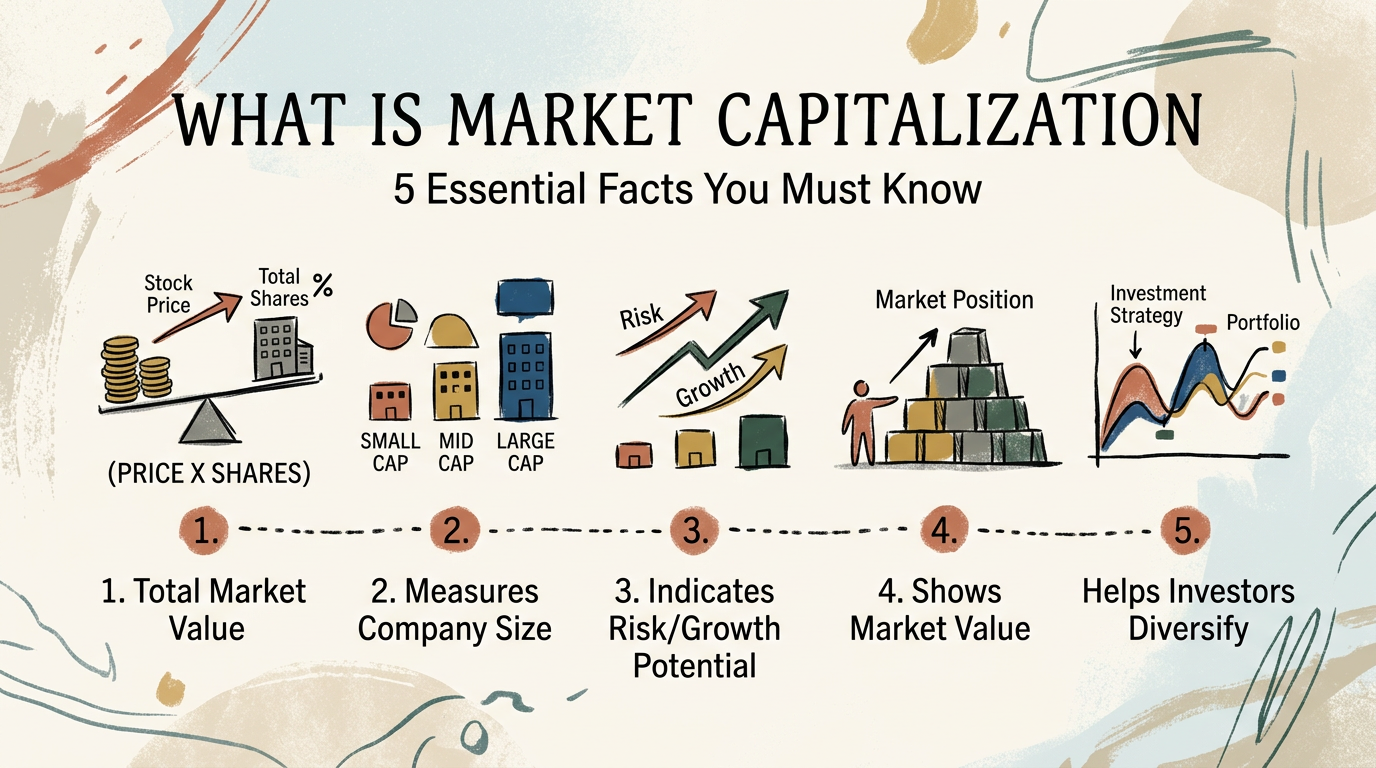
Understanding the fundamental metrics of the stock market is essential for any investor looking to build long-term wealth. One of the most important concepts to grasp is what is market capitalization. It serves as the primary way to determine the size and value of a publicly traded company.
Many beginners confuse share price with the actual value of a business. However, a low share price does not necessarily mean a company is cheap, nor does a high price mean it is expensive. To truly understand what is market capitalization, you must look at the total market value of all outstanding shares.
By mastering this metric, you can make better decisions regarding your money management strategy. It helps you categorize companies into large-cap, mid-cap, and small-cap segments, which is vital for risk assessment.
The Core Definition of Market Capitalization
At its simplest level, what is market capitalization? It is the total dollar value—or in our case, the total value in Indian Rupees—of a company’s outstanding shares of stock. It is calculated by multiplying the current market price of one share by the total number of outstanding shares.
This figure represents what the market believes the company is worth at any given moment. It is a dynamic number that changes every second during trading hours as the share price fluctuates. Investors use this to compare the relative size of one company against another.
1. The Simple Formula for Calculation
To calculate this metric yourself, you only need two pieces of data. First, find the current share price of the company. Second, identify the total number of outstanding shares, which can be found in the company’s latest balance sheet or financial reports.
The formula is: Market Cap = Current Share Price × Total Outstanding Shares. For example, if a company has 10 crore shares outstanding and the current price is ₹500, the market capitalization is ₹5,000 crore.
2. Why Market Capitalization Matters for Investors
Knowing what is market capitalization helps you understand the risk profile of your investments. Large-cap companies are generally considered more stable and established. They often provide steady dividends and are less volatile during market downturns.
Conversely, small-cap companies offer higher growth potential but come with significantly more risk. They are more susceptible to economic shifts and market volatility. By understanding what is market capitalization, you can ensure your portfolio aligns with your personal risk tolerance.
3. How Regulatory Bodies View Market Value
The Reserve Bank of India and SEBI monitor market trends to ensure stability. They use aggregate market data to assess the health of the financial system. For an individual investor, this highlights that market cap is not just a number; it is a reflection of systemic confidence.
When you ask what is market capitalization, you are essentially asking how the collective market values a firm’s future earnings potential. It is the price tag the public puts on a business.
4. Comparing Large, Mid, and Small-Cap Stocks
Market capitalization is the standard way to classify stocks in India. Large-cap companies are typically the top 100 companies by market cap. Mid-cap companies rank from 101 to 250, while small-cap companies are those ranked 251 and beyond.
Understanding what is market capitalization allows you to diversify your portfolio effectively. A balanced portfolio often includes a mix of these categories to capture growth while maintaining stability. It is a cornerstone of intelligent investing.
5. Limitations of Using Market Cap Alone
While useful, what is market capitalization does not tell the whole story. It does not account for debt, cash on hand, or the intrinsic value of the company’s assets. A company with high debt might have a high market cap but could be financially unstable.
Always combine market cap with other valuation metrics like the Price-to-Earnings (P/E) ratio. By looking at the bigger picture, you avoid the trap of relying on a single number. Remember, what is market capitalization is just one piece of the puzzle in your investment journey.