
Navigating the digital asset landscape requires more than just market intuition; it demands a deep understanding of the regulatory framework. As we look toward the future, the tax on crypto in india 2026 remains a significant hurdle for retail investors and institutional traders alike. Understanding these implications is vital for effective money management in the modern era.
The Indian government has established a rigid structure for Virtual Digital Assets (VDAs). This article provides a comprehensive reality check on why the current system is designed to discourage speculative trading through punitive taxation.
The 30% Reality Check: Understanding VDA Taxation
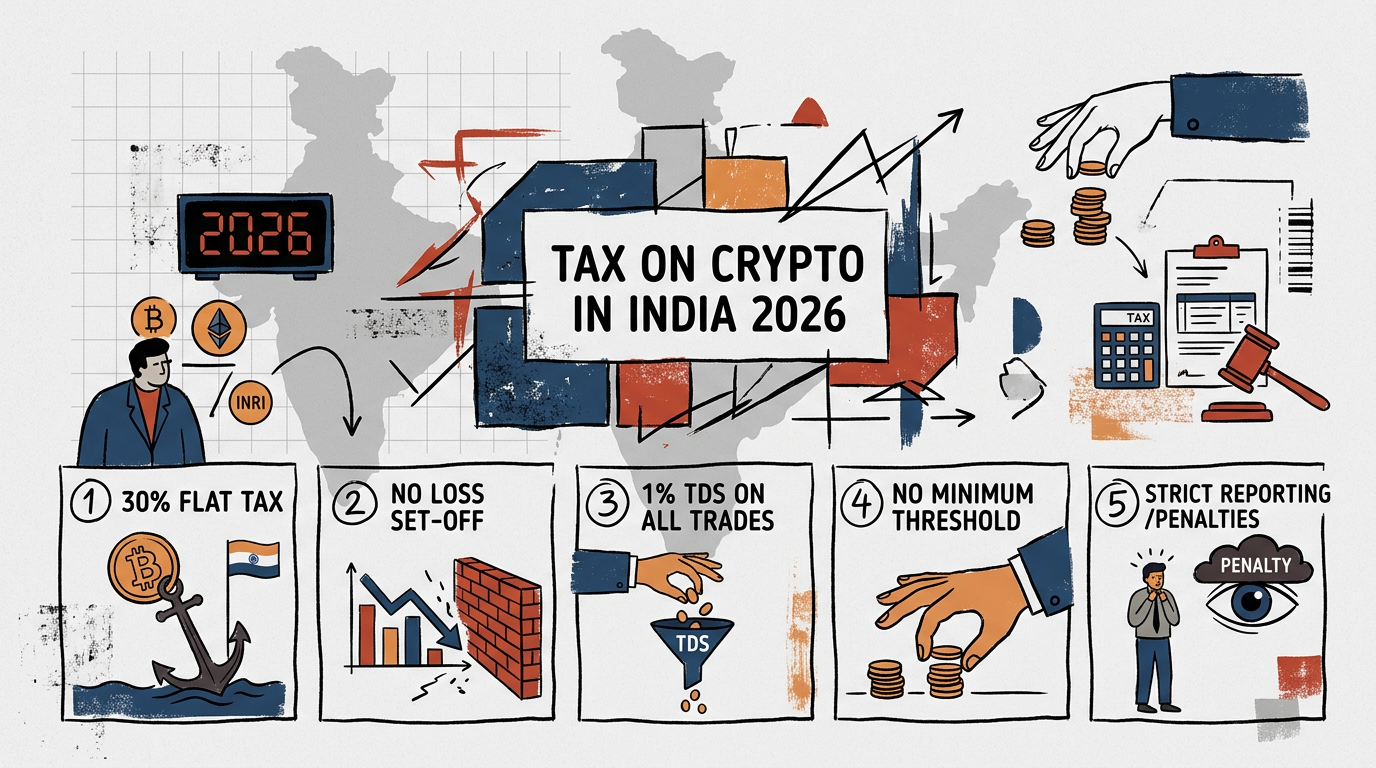
The most critical aspect of the tax on crypto in india 2026 is the flat 30% tax rate applied to income from the transfer of any VDA. This rate is non-negotiable and applies regardless of your total annual income or tax slab. It is a blunt instrument designed to curb speculative fervor.
Furthermore, this tax is levied on the gross profit of each transaction. You are not taxed on your net annual gains, but rather on the gains realized from each individual sale. This creates a massive cash flow challenge for active traders.
1. The No-Offset Rule for Crypto Losses
Perhaps the most painful component of the tax on crypto in india 2026 is the prohibition on offsetting losses. In traditional equity markets, you can often set off losses from one asset against gains from another to reduce your total tax liability.
Under current Indian tax law, you cannot offset losses incurred from one crypto asset against profits made from another. If you lose ₹50,000 on Bitcoin but gain ₹50,000 on Ethereum, you are still liable to pay 30% tax on the ₹50,000 gain from Ethereum. The loss on Bitcoin is effectively ignored by the tax authorities.
2. The Absence of Deductions for Expenses
Many investors mistakenly believe they can deduct expenses related to their crypto activities. However, the tax on crypto in india 2026 framework explicitly states that no deduction is allowed for any expenditure, other than the cost of acquisition.
This means you cannot deduct internet costs, hardware expenses, or even trading platform fees from your taxable income. The cost of acquisition is the only factor the Income Tax Department recognizes when calculating your capital gains.
3. The Impact of the 1% TDS Requirement
Beyond the 30% tax, the 1% Tax Deducted at Source (TDS) on the sale of VDAs acts as a constant drain on liquidity. This 1% is deducted at the time of the transaction, effectively acting as an advance tax payment.
While you can claim this 1% TDS back when filing your annual returns, it remains locked in the government’s coffers for months. For high-frequency traders, this represents a significant opportunity cost that compounds the burden of the tax on crypto in india 2026.
4. Compliance and the Risk of Non-Disclosure
The government has integrated VDA transactions into the Annual Information Statement (AIS). This means your crypto trades are visible to tax authorities, making non-disclosure a dangerous strategy.
Failure to report these gains correctly can lead to heavy penalties and interest charges. Given the strict nature of the tax on crypto in india 2026, maintaining meticulous records of every transaction is no longer optional; it is a necessity for financial survival.
5. Long-Term Implications for Crypto Adoption
The current tax regime is clearly designed to prioritize stability over speculative growth. By making it expensive to trade, the government is signaling a preference for long-term holding or, more likely, a complete shift toward regulated financial instruments.
Investors must weigh these costs carefully. When you factor in the 30% tax, the 1% TDS, and the inability to offset losses, the tax on crypto in india 2026 significantly erodes the potential for meaningful returns, making it essential to evaluate your portfolio strategy through a lens of extreme caution.
Ultimately, the tax on crypto in india 2026 serves as a reminder that the regulatory environment is not friendly to active trading. Whether you are holding Bitcoin or Ethereum, the fiscal reality remains the same: the government takes a significant share of your gross profits, leaving little room for error.
As you plan your financial future, remember that staying informed is your best defense. The tax on crypto in india 2026 is here to stay, and adapting your strategy to these constraints is the only way to navigate the market responsibly.