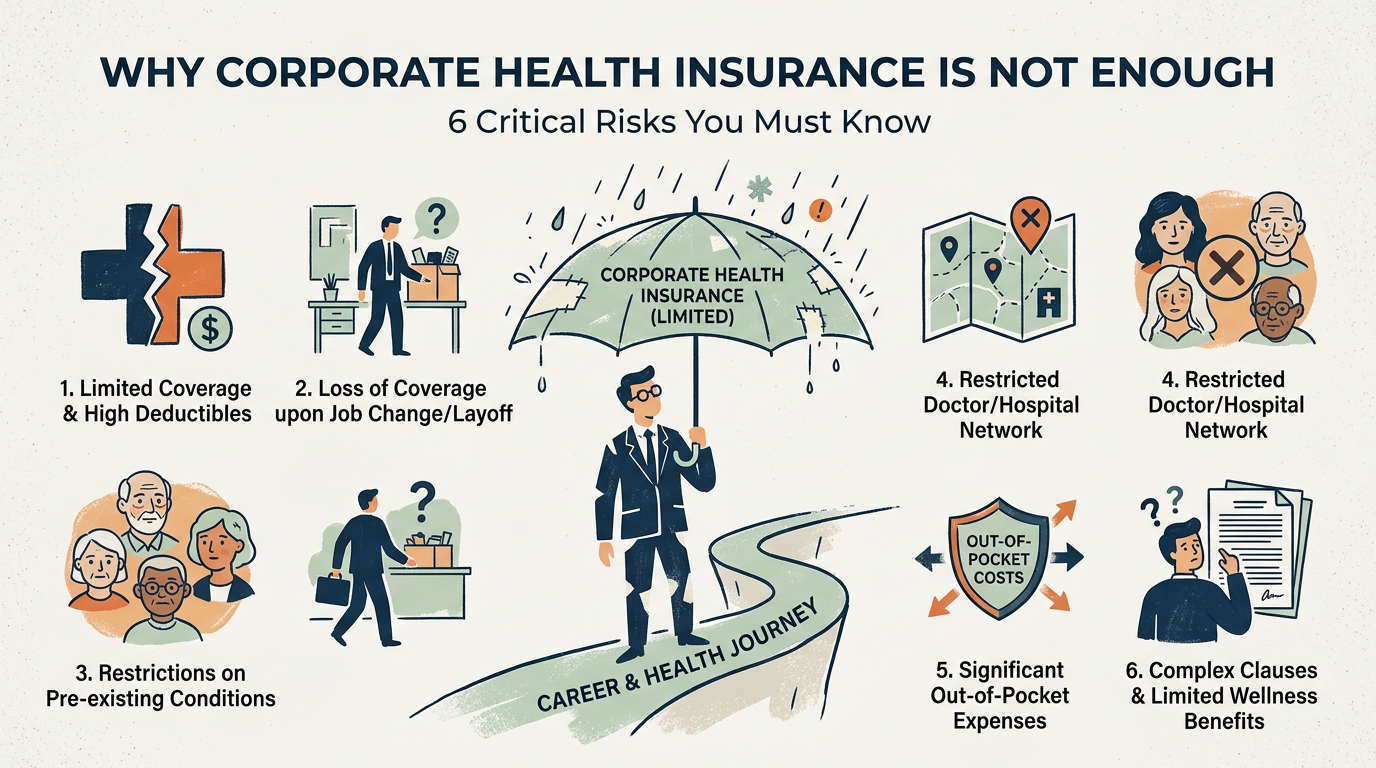
In the modern professional landscape, many employees view their employer-provided coverage as a complete safety net. However, relying solely on this can be a dangerous financial gamble. Understanding why corporate health insurance is not enough is the first step toward true financial security.
When you depend entirely on your company’s policy, you are essentially holding a “borrowed umbrella.” It works perfectly while you are employed, but the moment you leave, that protection vanishes. For comprehensive money management, you must look beyond these corporate perks.
The Hidden Risks of Relying on Employer Coverage
Most corporate plans are designed for the average employee, not for your specific family health history. If you face a major medical crisis, the sum insured provided by your employer might be woefully inadequate.
Furthermore, these policies are often subject to change at the company’s discretion. Your employer can reduce benefits, increase deductibles, or even cancel the policy entirely during the next renewal cycle.
1. The “Borrowed Umbrella” Effect Upon Job Loss
The most significant reason why corporate health insurance is not enough is the lack of portability. If you are laid off or decide to resign, your coverage typically terminates on your last working day.
Imagine being between jobs and facing a medical emergency. Without a personal policy, you would be forced to pay out-of-pocket, which could easily exceed ₹5,00,000 or more for a single hospitalization.
2. Inadequate Coverage for Critical Illnesses
Corporate policies often come with sub-limits on room rent and specific treatments. These restrictions can lead to massive out-of-pocket expenses even if the total bill is within your sum insured.
A personal health insurance plan allows you to choose a policy that covers modern treatments and critical illnesses without restrictive sub-limits. This is why financial experts emphasize that why corporate health insurance is not enough for long-term protection.
3. The Retirement Gap
Many employees fail to realize that their corporate health insurance will not follow them into retirement. Once you stop working, you lose your coverage exactly when you need it the most.
Purchasing a new health insurance policy at age 60 is significantly more expensive than starting one in your 30s. You may also face waiting periods for pre-existing conditions, leaving you vulnerable during your golden years.
4. Lack of Customization for Family Needs
Corporate plans are “one size fits all.” They rarely account for the specific medical needs of your spouse, children, or dependent parents.
By opting for an individual or family floater plan, you gain control over the sum insured and the scope of coverage. This customization is a primary reason why corporate health insurance is not enough for families with unique health requirements.
5. The Impact of Inflation on Medical Costs
Medical inflation in India is rising rapidly. A sum insured of ₹3,00,000 that seems sufficient today may not even cover a standard surgery in five years.
Corporate policies rarely adjust for inflation unless the company decides to upgrade the entire group plan. Maintaining a personal policy ensures you have a growing safety net that keeps pace with rising costs.
6. Regulatory Oversight and Consumer Protection
When you hold a personal policy, you have a direct contract with the insurer. You are protected by the guidelines set by the Reserve Bank of India and the IRDAI regarding claim settlements and grievances.
In contrast, if a dispute arises with a corporate policy, you are often at the mercy of your company’s HR department. This lack of direct control is a critical factor in why corporate health insurance is not enough.
Conclusion: Building a Robust Safety Net
While corporate insurance is a great supplementary benefit, it should never be your primary defense. The risks of job loss, retirement, and inadequate coverage are simply too high to ignore.
To secure your financial future, you must invest in a personal health insurance plan today. Understanding why corporate health insurance is not enough allows you to take proactive steps to protect your savings.
Do not wait for a life event to realize your vulnerability. Evaluate your current coverage, identify the gaps, and supplement your employer’s plan with a robust personal policy immediately. Remember, why corporate health insurance is not enough is a lesson best learned before a medical emergency occurs, not during one.
“””,meta_description: