
Navigating the complexities of the Indian tax regime often feels like solving a difficult puzzle. Among the various components of your salary structure, the House Rent Allowance (HRA) stands out as a significant tax-saving tool. Understanding HRA calculation basics is essential for every salaried individual looking to optimize their tax liability.
When you receive a salary slip, you will notice a specific component labeled HRA. This allowance is provided by employers to help employees cover the costs of rented accommodation. However, the amount you receive is not automatically exempt from tax. You must follow specific rules to claim the benefit effectively.
To master HRA calculation basics, you need to understand that the exemption is governed by Section 10(13A) of the Income Tax Act. It is not a flat deduction; rather, it is calculated based on the lowest of three specific criteria. If you are struggling to organize your finances, consider reading our guide on money management to better structure your overall savings.
Understanding the Mechanics of HRA
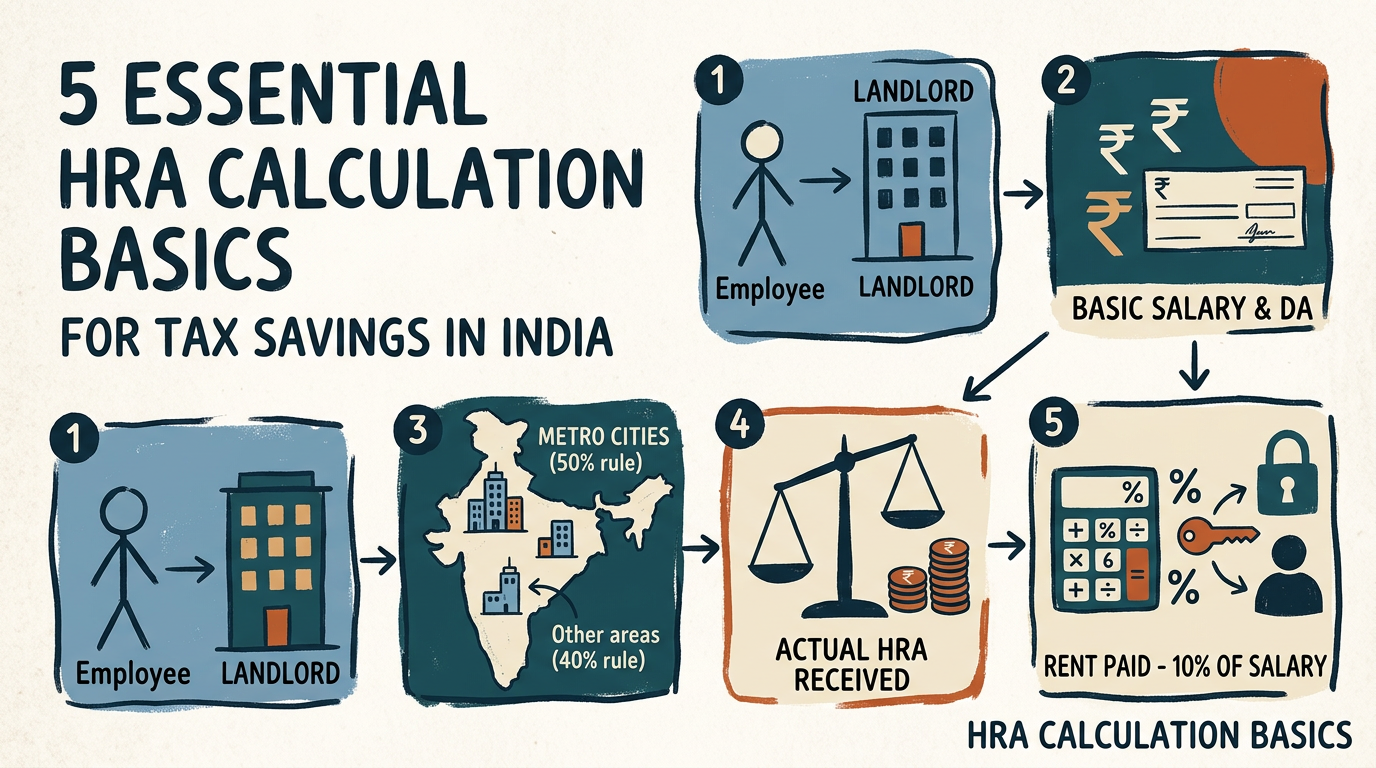
The core of HRA calculation basics lies in comparing three distinct figures. The tax department allows you to claim an exemption on the minimum of these three amounts. This ensures that the tax benefit is proportionate to your actual rent paid and your salary structure.
Many taxpayers assume that the entire HRA received is tax-free. This is a common misconception that leads to tax notices. By learning the HRA calculation basics, you can plan your housing expenses in a way that maximizes your take-home pay.
1. Actual HRA Received from Your Employer
The first component in our HRA calculation basics is the actual amount of HRA provided by your employer. You can find this figure clearly stated in your monthly salary slip or your annual appointment letter. If your employer does not provide an HRA component, you cannot claim this specific exemption.
2. Actual Rent Paid Minus 10% of Basic Salary
The second pillar of HRA calculation basics involves your actual expenditure. You must calculate the rent paid by you annually and subtract 10% of your basic salary plus Dearness Allowance (DA). This figure represents the “excess” rent you are paying over the threshold set by the tax authorities.
3. Percentage of Salary Based on Location
The final factor in HRA calculation basics depends on where you live. If you reside in a metro city (Delhi, Mumbai, Kolkata, or Chennai), the limit is 50% of your basic salary plus DA. For non-metro cities, the limit is 40% of your basic salary plus DA.
4. The Importance of Rent Receipts and PAN
To ensure your HRA calculation basics hold up during an audit, documentation is vital. You must maintain valid rent receipts for every month you claim the exemption. Furthermore, if your annual rent exceeds ₹1,00,000, you are mandatory required to provide the Permanent Account Number (PAN) of your landlord to your employer.
5. Impact of Salary Components on Tax
Your basic salary is the anchor for these calculations. When negotiating your CTC, keep in mind that a higher basic salary increases the 10% deduction threshold. Always refer to the official guidelines provided by the Reserve Bank of India regarding broader economic policies that may influence inflation and rental trends in your city.
By following these HRA calculation basics, you can accurately estimate your tax-exempt portion. Remember, the goal is to reduce your taxable income legally. If your calculated exemption is lower than the HRA received, the difference is added to your taxable income and taxed according to your applicable slab rate.