
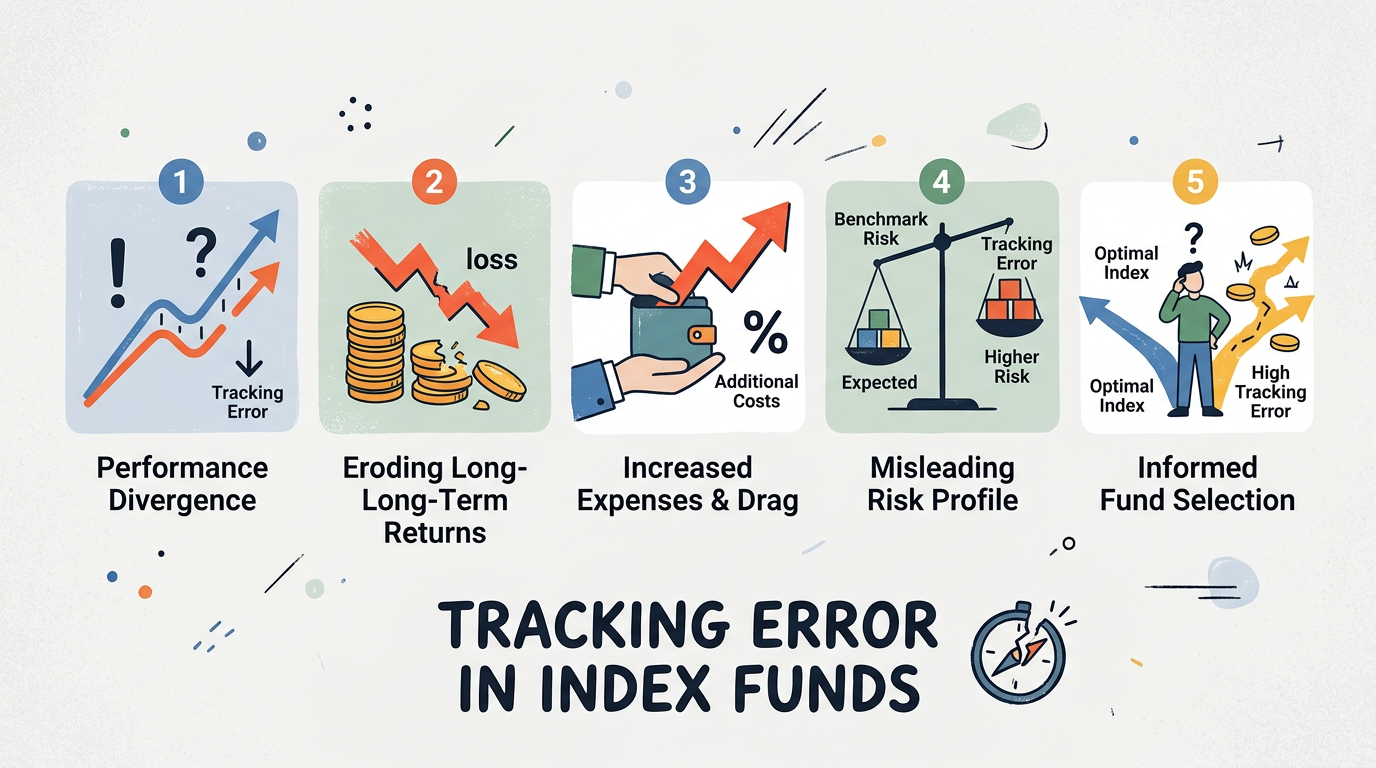
Investing in index funds is often hailed as the smartest way to build long-term wealth. By mirroring a market index, these funds aim to provide returns similar to the broader market. However, there is a silent factor that can erode your gains: tracking error in index funds.
When you invest, you expect your fund to behave exactly like the index it tracks. Yet, reality often differs. Understanding tracking error in index funds is crucial for any serious investor looking to optimize their portfolio performance.
What Exactly is Tracking Error?
Think of an index fund as a shadow of the market index. Ideally, the shadow should move in perfect synchronization with the object. Tracking error in index funds represents the deviation between the fund’s returns and the index’s returns.
If the Nifty 50 rises by 10%, but your fund only rises by 9.5%, that 0.5% difference is the tracking error. It is essentially the cost of inefficiency in replicating the market.
Why Does Tracking Error Happen?
Several factors contribute to this phenomenon. Primarily, it is caused by the fund’s expense ratio, cash holdings, and the timing of trades. Even the Reserve Bank of India policies can indirectly influence market liquidity, affecting how funds manage their portfolios.
Investors must realize that no index fund can perfectly replicate an index due to these practical constraints. However, keeping tracking error in index funds at an absolute minimum is the hallmark of a well-managed fund.
1. The Impact of Expense Ratios
Every index fund charges a fee, known as the expense ratio. This fee is deducted from the fund’s assets, which directly lowers the net returns compared to the index. If a fund has an expense ratio of 0.50%, the tracking error in index funds will naturally be higher than a fund with a 0.10% ratio.
2. Cash Drag and Liquidity Management
Index funds must hold a small portion of their portfolio in cash to handle redemptions. Because cash does not earn market returns, it creates a drag on performance. This is a common source of tracking error in index funds, especially during volatile market phases.
3. Dividend Reinvestment Delays
When the stocks within an index pay dividends, the index reflects these gains immediately. However, the fund manager must receive these dividends and reinvest them. This time lag results in a slight performance gap, contributing to the overall tracking error in index funds.
4. Impact of Portfolio Rebalancing
Indices are rebalanced periodically to reflect changes in the market. If a fund manager is slow to execute these trades or incurs high transaction costs, the fund will drift away from the index. Minimizing this drift is essential for effective money management.
5. Securities Lending Income
Some funds engage in securities lending to earn extra income, which can offset the expense ratio. While this can help reduce the tracking error in index funds, it also introduces counterparty risk that investors should carefully evaluate.
How to Evaluate Tracking Error
When selecting a fund, look at the historical tracking error data provided in the fund’s fact sheet. A lower number indicates that the fund manager is doing an excellent job of mirroring the index. Always compare funds with similar investment objectives to ensure you are getting the best value for your ₹10,000 or ₹1,00,000 investment.
Conclusion
While you cannot eliminate tracking error in index funds entirely, you can certainly choose funds that manage it effectively. Prioritize funds with low expense ratios and high assets under management to ensure your portfolio stays closely aligned with your financial goals.