
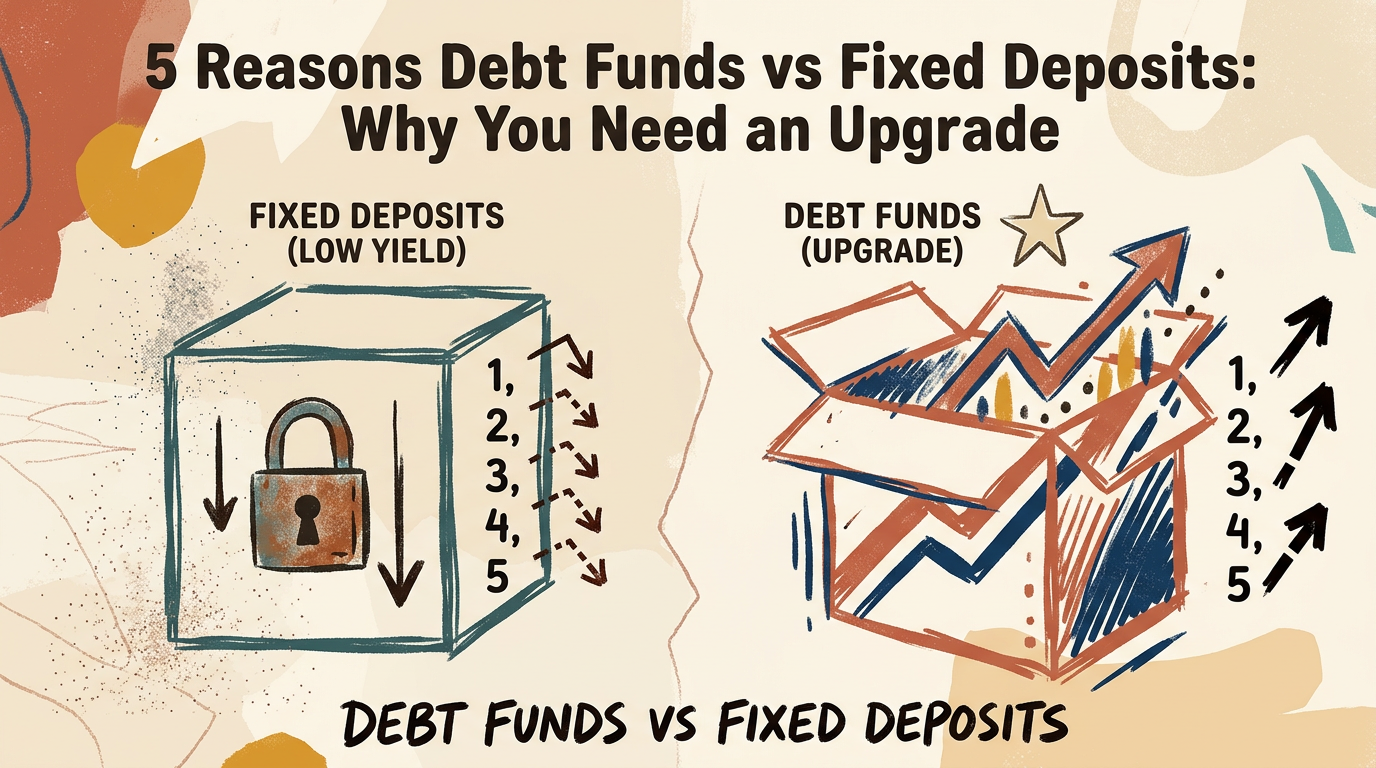
For generations, Indian families have relied on the safety of bank deposits to grow their wealth. However, as financial literacy evolves, many investors are questioning the traditional debt funds vs fixed deposits comparison. While your grandfather swore by the predictability of a Fixed Deposit (FD), modern investors are finding that debt mutual funds offer a more sophisticated, tax-efficient alternative.
Understanding the nuances of debt funds vs fixed deposits is essential for anyone looking to optimize their portfolio. While both instruments aim to preserve capital, they operate on entirely different mechanisms. This guide will break down why your investment strategy might need an upgrade.
Understanding the Core Differences
At their heart, both instruments are debt-based. When you open an FD, you are essentially lending money to a bank for a fixed tenure at a predetermined interest rate. When you invest in debt funds, you are pooling your money with other investors to buy a diversified portfolio of government securities, corporate bonds, and money market instruments.
The primary debate regarding debt funds vs fixed deposits often centers on liquidity and taxation. While FDs are rigid, debt funds offer daily liquidity, allowing you to withdraw your money whenever the need arises without significant penalties. Mastering money management requires understanding these liquidity trade-offs.
1. The Taxation Advantage of Debt Funds
The most significant differentiator in the debt funds vs fixed deposits debate is how the government taxes your gains. Interest earned on an FD is added to your income and taxed according to your slab rate. If you are in the 30% tax bracket, your effective return is significantly eroded.
Conversely, debt funds offer the benefit of indexation. Indexation allows you to adjust the purchase price of your investment for inflation, effectively lowering your taxable capital gains. This makes debt funds a superior choice for investors in higher tax brackets looking for long-term wealth preservation.
2. Market-Linked Returns vs Fixed Rates
Fixed Deposits provide a guaranteed return, which is comforting but often fails to beat inflation significantly. In contrast, debt funds provide market-linked returns. When interest rates in the economy fall, the prices of existing bonds in a debt fund rise, potentially offering capital appreciation.
While this introduces a degree of volatility, it allows investors to capture upside potential that FDs simply cannot provide. For those monitoring the Reserve Bank of India policy shifts, debt funds act as a dynamic tool to navigate interest rate cycles.
3. Diversification and Risk Management
An FD is exposed to the credit risk of a single bank. While Indian banks are generally safe, diversification is the bedrock of sound investing. A debt fund spreads your risk across dozens of different issuers, including government entities and high-rated corporations.
This professional management ensures that your money is not tied to the fortunes of one institution. By comparing debt funds vs fixed deposits, it becomes clear that the former offers a more robust framework for risk mitigation through diversification.
4. Liquidity and Accessibility
Life is unpredictable, and sometimes you need access to your funds on short notice. Breaking an FD prematurely often results in a penalty, reducing your overall yield. Debt funds, however, are highly liquid.
Most debt funds allow you to redeem your units and receive the proceeds in your bank account within 24 to 48 hours. This flexibility makes debt funds vs fixed deposits a clear win for emergency funds or short-term parking of surplus cash.
5. The Power of Compounding
While both instruments benefit from compounding, the tax efficiency of debt funds means you retain more of your earnings to reinvest. Over a 10-year horizon, the difference between paying tax on interest annually versus paying lower capital gains tax at the end can result in a significant difference in your final corpus.
When analyzing debt funds vs fixed deposits, always look at the post-tax yield rather than the headline interest rate. The modern investor prioritizes net-in-hand returns over gross interest figures.
Conclusion: Making the Switch
The comparison of debt funds vs fixed deposits is not about declaring one “bad” and the other “good.” It is about choosing the right tool for your specific financial goals. If you prioritize absolute certainty and have zero appetite for market fluctuation, an FD remains a valid option.
However, if you are looking for tax efficiency, liquidity, and the potential to outperform inflation, debt funds are the clear upgrade. By understanding the debt funds vs fixed deposits dynamic, you can ensure your hard-earned ₹1,00,000 works as hard as possible for your future.