
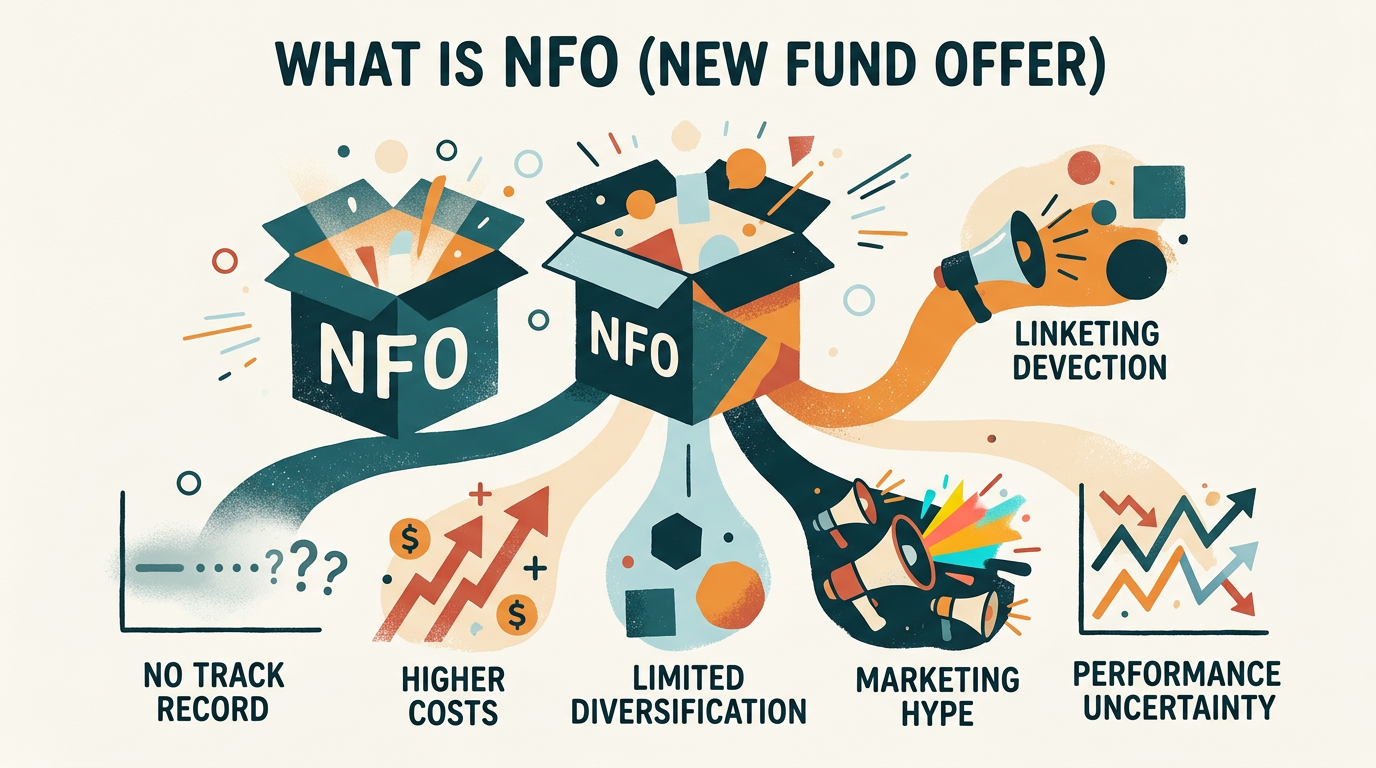
When you start your journey into mutual fund investing, you will frequently hear about the latest what is NFO (New Fund Offer) marketing campaigns. Asset Management Companies (AMCs) often create a sense of urgency, suggesting that these new funds are a “once-in-a-lifetime” opportunity to invest at a low price of ₹10 per unit. However, seasoned investors know that this is often a marketing trap.
At money management, we believe in data-driven decisions rather than hype. Understanding what is NFO (New Fund Offer) is the first step toward protecting your hard-earned capital from unnecessary risks. In this guide, we will dissect why these new offerings are rarely the best choice for your portfolio.
Understanding the Mechanics of an NFO
An NFO is essentially the initial public offering of a mutual fund scheme. When a fund house launches a new product, they invite investors to subscribe to it for a limited period. The primary goal of the AMC is to gather assets under management (AUM) to start their investment strategy.
Many beginners mistakenly believe that buying at ₹10 is “cheap.” In reality, the Net Asset Value (NAV) of a fund is irrelevant to its future performance. Whether you buy a fund at ₹10 or ₹100, you are buying a proportionate share of the underlying assets. If those assets grow by 10%, your investment grows by 10% regardless of the entry price.
1. The Lack of Performance History
The most significant danger when asking what is NFO (New Fund Offer) is the complete absence of a track record. When you invest in an existing fund, you can analyze its performance across different market cycles, including bull runs and bear markets. You can see how the fund manager handled volatility.
With an NFO, you are essentially investing in a “black box.” You have no data to verify if the fund manager’s strategy actually works in real-world conditions. You are trusting the marketing brochure rather than proven results.
2. The Absence of Portfolio Transparency
Existing mutual funds provide monthly fact sheets that disclose their entire portfolio. This allows you to see exactly where your money is going and if the fund aligns with your risk appetite. NFOs do not have this history.
Because the fund is new, the manager has not yet built a portfolio. You have no way of knowing if they will stick to the stated investment objective or if they will deviate under pressure. This lack of transparency is a major red flag for conservative investors.
3. Higher Risk of Strategy Failure
Every fund manager has a specific style, but that style is only proven once it has been tested. When you research what is NFO (New Fund Offer), consider that many new funds are launched simply to fill a gap in the AMC’s product lineup. This is often done to capture market trends rather than to provide long-term value.
If the strategy fails to gain traction or underperforms, the fund might be merged with another scheme or closed down. This creates unnecessary administrative headaches and potential tax implications for the investor.
4. Superior Alternatives Exist
Why settle for an unproven NFO when you have thousands of established funds with 5, 10, or 20 years of history? Established funds have survived multiple economic crises, such as the 2008 financial crash or the 2020 pandemic.
By choosing an existing fund, you benefit from the wisdom of the Reserve Bank of India regulations that ensure transparency and disclosure standards are met over time. You are paying for a proven process, not a marketing experiment.
5. The Marketing Trap of “Low NAV”
The biggest myth surrounding what is NFO (New Fund Offer) is that a lower NAV means more units for your money. If you invest ₹10,000 in a fund with a NAV of ₹10, you get 1,000 units. If you invest ₹10,000 in a fund with a NAV of ₹100, you get 100 units.
If both funds invest in the same underlying stocks and those stocks rise by 10%, your ₹10,000 becomes ₹11,000 in both scenarios. The number of units is mathematically irrelevant. Do not let the “cheap” price tag influence your investment strategy.
Why You Should Stick to Proven Funds
When you finally grasp what is NFO (New Fund Offer), the conclusion is clear: stick to what works. Experienced investors look for consistent alpha, low expense ratios, and a stable management team. None of these can be verified in a new fund.
If you are looking to build wealth, focus on funds that have demonstrated their ability to beat their benchmarks over long periods. A fund with a 10-year track record is a much safer bet than a brand-new product launched to capitalize on a market trend.
Final Thoughts on NFOs
Ultimately, what is NFO (New Fund Offer) is a question of risk versus reward. The reward for investing in an NFO is non-existent, while the risk of underperformance is significantly higher than that of established funds. Always prioritize historical performance and transparency over the allure of a new launch.
Before you invest, ask yourself: “Does this fund offer something that a proven, existing fund does not?” In 99% of cases, the answer is no. Keep your portfolio simple, proven, and focused on long-term growth.