
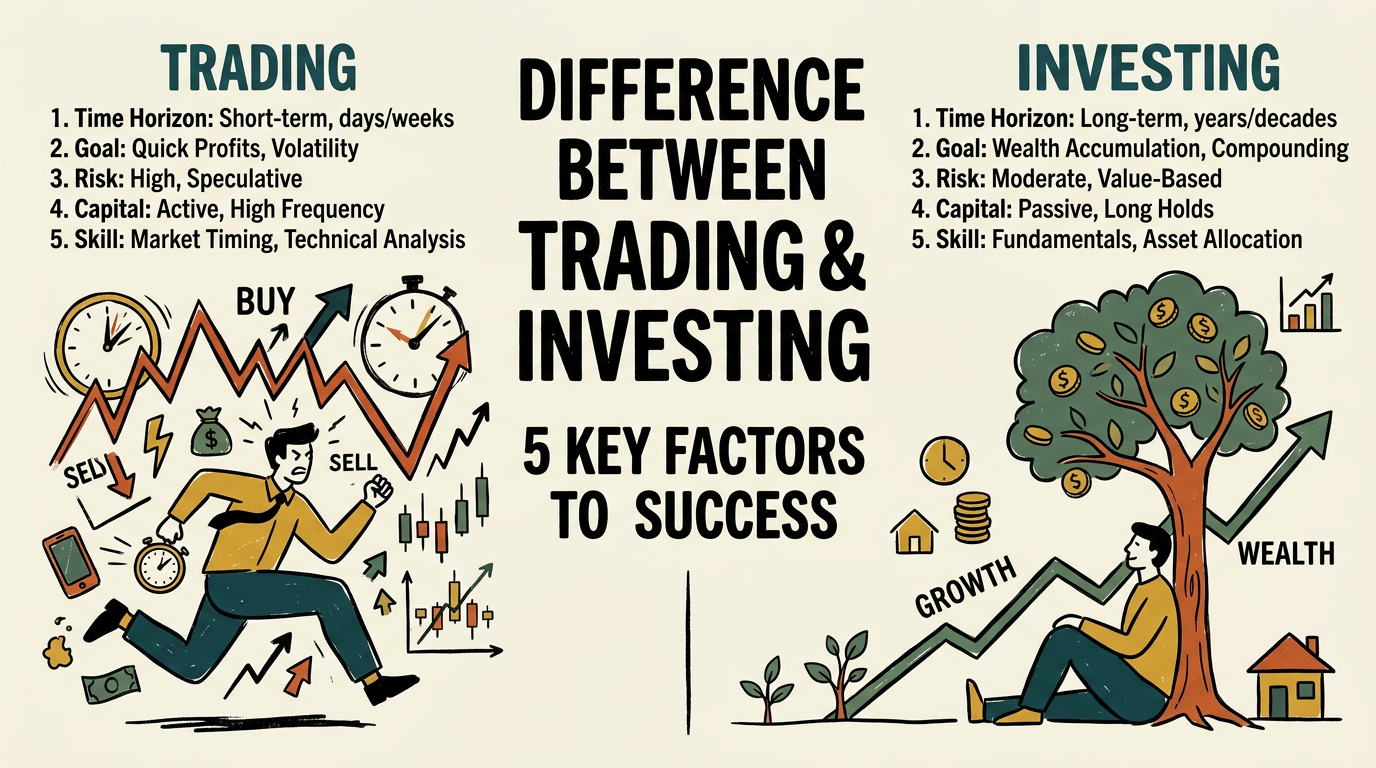
Understanding the difference between trading and investing is the most critical step for anyone looking to build wealth in the Indian stock market. Many beginners jump into the market without realizing that these two approaches require completely different mindsets, time horizons, and risk management strategies.
Think of the stock market like cricket. If investing is a Test match—demanding patience, strategy, and a long-term view—then trading is a T20 match—fast-paced, high-intensity, and focused on quick gains. Choosing the wrong style for your personality can lead to significant financial loss.
In this guide, we break down the difference between trading and investing to help you decide which path aligns with your financial goals. Whether you are looking for long-term wealth creation or short-term profit, mastering the fundamentals of money management is essential.
Understanding the Core Philosophy
At its heart, the difference between trading and investing lies in the intent. An investor buys an asset because they believe in the long-term value of the underlying business. A trader buys an asset because they believe they can sell it for a higher price in the near future, regardless of the company’s long-term health.
To deepen your understanding of market regulations, you can refer to the Reserve Bank of India guidelines on financial stability. Now, let’s explore the 5 key areas where these two strategies diverge.
1. Time Horizon and Commitment
The most obvious difference between trading and investing is the time spent holding the asset. Investors hold stocks for years or even decades, allowing the power of compounding to work its magic. Traders, however, may hold positions for only a few minutes, hours, or days.
- Investing: Focuses on long-term growth and dividend income.
- Trading: Focuses on short-term price fluctuations and market volatility.
2. Risk Management Strategies
When analyzing the difference between trading and investing, risk management is the deciding factor. Investors accept market volatility as a temporary hurdle, knowing that quality companies often recover over time. Traders must use strict stop-loss orders to protect their capital because a single bad trade can wipe out a significant portion of their portfolio.
- Investing: Risk is mitigated through diversification and fundamental analysis.
- Trading: Risk is managed through technical analysis and tight exit strategies.
3. Analytical Approach
Investors rely on fundamental analysis to determine the intrinsic value of a company. They look at balance sheets, profit margins, and management quality. Traders rely on technical analysis, using charts, patterns, and volume data to predict where the price will move next.
Understanding this difference between trading and investing is vital. You cannot trade effectively without technical skills, and you cannot invest wisely without fundamental knowledge.
4. Capital Requirements and Costs
Trading often requires frequent buying and selling, which leads to higher brokerage fees, taxes, and transaction costs. These costs can eat into your profits if not managed correctly. Investing involves fewer transactions, which keeps the cost of ownership low and allows your ₹10,000 or ₹1,00,000 investment to grow undisturbed.
The difference between trading and investing in terms of costs can significantly impact your net returns over a five-year period.
5. Psychological Demands
Trading is mentally exhausting. It requires constant monitoring of the screen and the ability to make split-second decisions under pressure. Investing is more about emotional discipline and the ability to ignore market noise. If you cannot handle the stress of a 5% drop in a single day, trading might not be for you.
Conclusion: Which Path Should You Choose?
Ultimately, the difference between trading and investing comes down to your personal goals and risk appetite. If you want to build a retirement corpus, investing is the proven path. If you have the time, skill, and appetite for high-risk, high-reward scenarios, trading could be an option.
Most successful market participants maintain a core portfolio of long-term investments while keeping a small portion of their capital for active trading. Regardless of your choice, always prioritize education and start with a small amount of capital.