
In the world of modern finance, building wealth often feels like navigating a complex maze. Many beginners look at the stock market and see individual stocks as single, risky fruits. If that fruit rots, your investment spoils. This is where understanding what are ETFs (Exchange Traded Funds) becomes a game-changer for your portfolio.
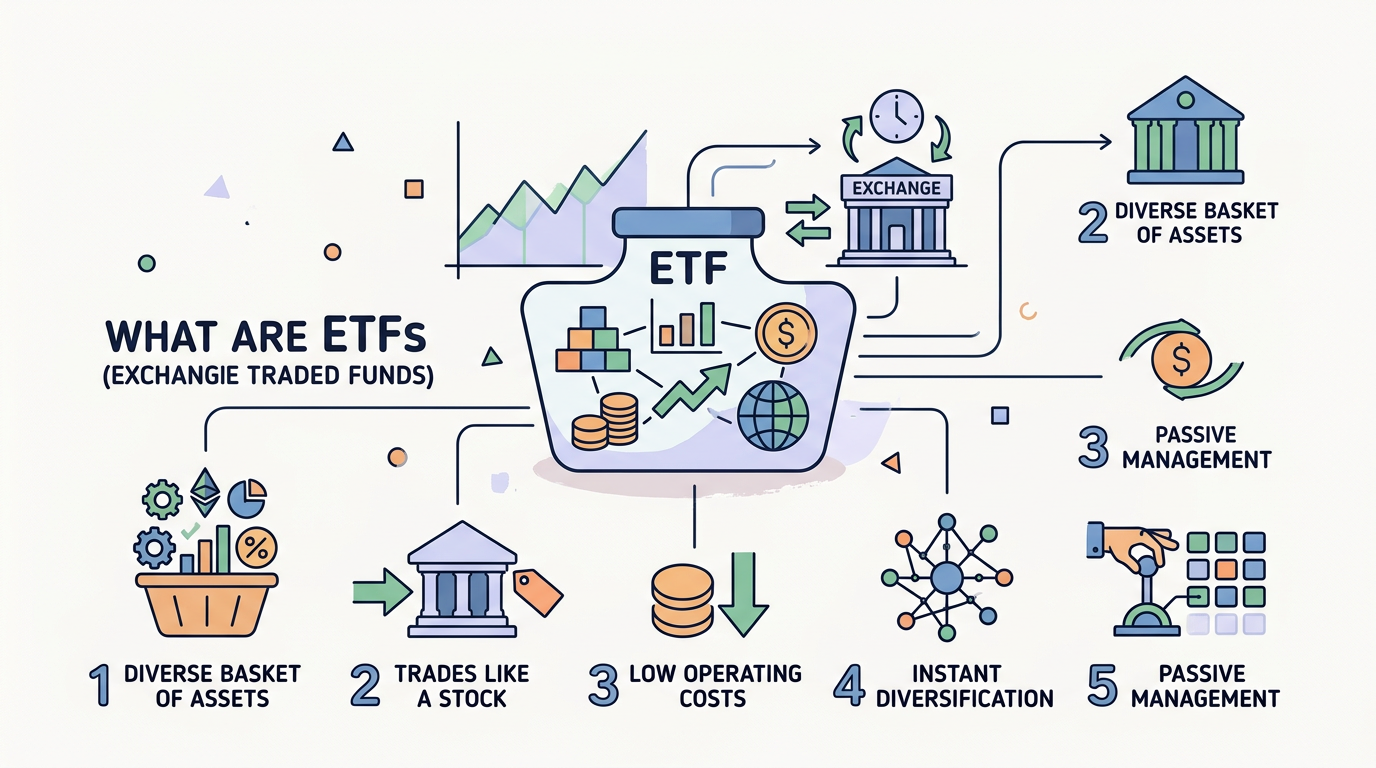
Think of an ETF as a pre-made fruit basket. Instead of picking one apple, you buy a basket containing apples, oranges, and bananas. The best part? You can trade this entire basket on the stock exchange throughout the day, just as easily as you would trade a single apple. This flexibility is why so many investors are shifting their focus toward these instruments.
Understanding the Basics of ETFs
At its core, an ETF is a collection of securities that tracks an underlying index. When you ask what are ETFs (Exchange Traded Funds), the simplest answer is that they combine the diversification of mutual funds with the liquidity of individual stocks. They are designed to mirror the performance of a specific market index, such as the Nifty 50.
Because they trade on an exchange, their price fluctuates in real-time. This is a significant departure from traditional mutual funds, which only calculate their Net Asset Value (NAV) once at the end of the trading day. For those interested in money management, this real-time transparency is invaluable.
1. The Convenience of Instant Liquidity
One of the primary reasons investors research what are ETFs (Exchange Traded Funds) is the ability to buy and sell them instantly. If you decide you need cash for an emergency, you do not have to wait for the market to close. You can execute a trade during market hours and receive your funds according to the settlement cycle.
This liquidity makes them ideal for both long-term investors and short-term traders. You are never locked into a position longer than you want to be. Whether you are investing ₹10,000 or ₹10,00,000, the process remains seamless and efficient.
2. Lower Costs Through Passive Management
Cost efficiency is a hallmark of these funds. Because most ETFs are passively managed—meaning they simply track an index rather than paying a fund manager to pick stocks—the expense ratios are typically much lower than actively managed mutual funds.
When you learn what are ETFs (Exchange Traded Funds), you realize that lower fees mean more of your money stays invested. Over a period of 10 to 20 years, these savings can compound into significant wealth. Always check the expense ratio before investing your hard-earned ₹5,000 or more.
3. Broad Diversification in a Single Trade
Diversification is the golden rule of investing. By purchasing a single ETF, you gain exposure to dozens or even hundreds of companies. This drastically reduces the risk associated with any single company failing.
If you are still wondering what are ETFs (Exchange Traded Funds), imagine owning a tiny slice of the entire Indian economy. By investing in a Nifty 50 ETF, you are essentially betting on the growth of the top 50 companies in India. It is a powerful way to mitigate risk without needing to research every individual stock.
4. Transparency in Portfolio Holdings
Unlike some mutual funds that only disclose their full holdings periodically, ETFs are highly transparent. You can see exactly what is inside your “fruit basket” at any given moment. This level of clarity helps investors make informed decisions about their financial future.
For official data and market guidelines, you can always refer to the Reserve Bank of India to understand the broader economic environment. Knowing what are ETFs (Exchange Traded Funds) allows you to align your investments with these macroeconomic trends effectively.
5. Tax Efficiency for Indian Investors
Taxation is a critical component of any investment strategy. In India, ETFs are generally considered tax-efficient because they do not trigger frequent capital gains distributions like some actively managed funds. This is because the underlying portfolio turnover is usually lower.
As you dive deeper into what are ETFs (Exchange Traded Funds), remember to consult with a tax professional regarding your specific bracket. Understanding the tax implications of your ₹1,00,000 investment is just as important as choosing the right fund.
How to Start Investing in ETFs
Getting started is straightforward. You will need a Demat and trading account with a registered broker. Once your account is active, you can search for the ticker symbol of the ETF you wish to purchase.
Many investors ask what are ETFs (Exchange Traded Funds) because they want a simple way to start their wealth-building journey. With as little as ₹500, you can begin building a diversified portfolio. Remember, consistency is the key to long-term success in the market.
Final Thoughts on ETF Investing
The beauty of these instruments lies in their simplicity. By viewing them as a pre-made basket of assets, you remove the stress of picking winners and losers. If you truly understand what are ETFs (Exchange Traded Funds), you have the tools to build a robust, low-cost portfolio that stands the test of time.
Always conduct your own research and assess your risk tolerance before committing your capital. With the right strategy, ETFs can serve as the foundation of your financial independence.